LaLota Fights for Long Island Coast Guard Families in Annual Defense Bill
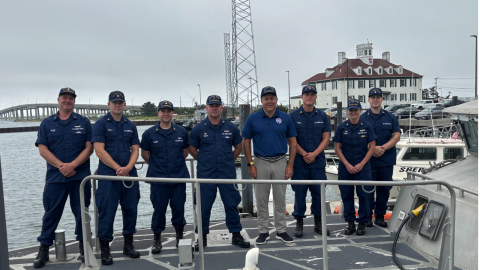
WASHINGTON, D.C. – Rep. Nick LaLota (R-Suffolk County), a Navy Veteran who served on three overseas deployments, released the following statement after voting to pass the bipartisan Streamlining Procurement for Effective Execution and Delivery and National Defense Authorization Act (NDAA) for Fiscal Year 2026 out of the House. The bill passed with support from 214 Republicans and 17 Democrats.
The legislation includes LaLota’s amendment requiring the Department of Defense and the Department of Homeland Security to examine commuting distances and housing allowances for Servicemembers in high-cost regions such as Long Island, where the lack of affordable housing has become a major challenge.
“During my recent visit to Coast Guard Station Shinnecock, multiple Coasties told me their housing allowance prevents them from affording a home within an hour of their duty station—hurting both their quality of life and their ability to serve effectively. No one wearing America’s uniform should be priced out of their post. My amendment is a first step toward fixing this problem, and I will keep fighting until our Servicemembers get the quality-of-life support they deserve,” said Rep. LaLota.
To read the full text of the legislation, click HERE.
Background:
After visiting Coast Guard Station Shinnecock in August and witnessing firsthand the stark commuting disparities between Long Island and the rest of the country, where for some servicemembers the trip to work can take more than two hours, Congressman LaLota successfully advanced an amendment to this year’s NDAA directing the Department of Defense, in consultation with the Department of Homeland Security, to study potential adjustments to Basic Allowance for Housing (BAH) calculations. The study will evaluate costs, savings, and impacts on quality of life, recruitment, and retention, with particular focus on areas experiencing significant seasonal swings in housing costs, such as eastern Long Island.
In the FY2026 NDAA are several of LaLota’s priorities:
Servicemembers’ Quality of Life:
- 3.8% pay raise for all Servicemembers
- Improves housing, education, and access to childcare for military families.
- Directions for DOD and DHS to conduct a study to evaluate potential adjustments to the methods for determining the monthly rates for the Basic Allowance for Housing (BAH), including
- Market analysis on the costs or savings of implementing a 120-minute or less round-trip driving time from a residence to the duty station
- An assessment of the impact on the quality of life, recruitment, and retention of members of the Armed Forces, particularly with respect to members assigned to unique geographic areas in which local housing conditions create disproportionate challenges, including
- Montauk, New York;
- Hampton Bays, New York; and
- Nantucket, Massachusetts.
- Over $2.8B for aircraft spare and repair parts, including
- $500M in additional F-35 spare and repair parts
- $250M for F-35A for the Air Force
- $125M for F-35B for the Marine Corps
- $125M for F-35C for the Navy
- $500M in additional F-35 spare and repair parts
- Over $8.2B for F-35 aircraft procurement
- $4B for F-35A for the Air Force
- $1.9B for F-35B for the Marine Corps
- $2.3B for F-35C for the Navy
Other Support for Key Defense Programs:
- $1.47B for hypersonic weapons programs, including
- $20M for integrated hypersonic propulsion technology maturation
- $353M for long-range hypersonic weapon
- $802M for hypersonic attack cruise missile
- $30M for hypersonic-specific test and evaluation infrastructure
- $76M for hypersonic technology development and transition
- $7.5M for next-generation hypersonic
- $200M for hypersonic defense
Defense Acquisitions Reform:
- Fundamentally reforms defense acquisitions - streamlining the process, cutting through red tape, and refocusing on its primary mission: getting our warfighters what they need when they need it.
Innovation and Defense Industrial Base:
- Expands U.S. production capacity and provides certainty to contractors, helping to rebuild the shrinking defense industrial base while encouraging new, innovative entrants.
- Makes Small Business Innovation Research (SBIR) Phase II permanent and extends authority to Small Business Technology Transfer (STTR)
- Authorize DoD from FY26-29 to award one additional sequential Phase II SBIR or STTR award to a small business that received an additional Phase II for continued work.
- Ensures our Armed Forces have the capabilities they need to prevail in the wars of tomorrow by accelerating innovation, prioritizing cutting-edge technologies like hypersonics and autonomous technologies.